No Booze Please, We’re British

When I was eighteen, I wangled a job with a local construction company in order to broaden my horizons. Admittedly, I wasn’t very adept with a set of tools, although I was thin enough to install insulation in loft spaces that might otherwise have cracked under the weight of your average workman. Some of this was down to genetics, sure, and the rest was probably alcohol consumption. On Friday, we would finish up early and make a dash for one of the four (yes, four) pubs in our sleepy village of just over a thousand inhabitants. On an adventurous night, we might make the hotel down the road – possibly making too much noise on the way over. And for those who found this too arduous, there was always the benefit of a lock-in, which came without a flicker of irregularity.
Now, far be it for me to discourage local business, but it doesn’t take a betting man to understand that we were all well gassed by the time we rolled out in the early hours. The ‘real’ drinkers (no doubt long since required to adjust their intake) might have got through twenty pints. Although this is too much by any stretch, the general scenario will be familiar: Britons like to drink. Is the wall of booze, however, slowly being dismantled? Those of the baby boomer generation are removing a brick at a time, and while Generation X is getting to work on dry January, Generation Z (those born after 1997) have gone and rigged up enough explosive to give Wile E. Coyote a bad name. Julie Buckley, Chief Operating Officer for Winetraders: ‘A sea change is coming because Generation Z are not alcohol drinkers. Culturally, they do not require alcohol to have a good time, and their level of understanding when it comes to alcohol’s harmful effects has certainly improved compared with previous generations.’ Recent data from the US shows that Generation Z are spending approximately one eighth the amount these previous generations did on the juice. Where does this leave the plucky independent?
According to Statista, wine consumption in the UK has remained almost static for the last 20 years, although the way in which we drink has undoubtedly changed for the good. This really is the key, for there are plenty out there who drink moderately and drink well. Wine is a social unifier that adds tremendous value to many occasions, not least at the dinner table, where it serves to refresh the palate and aid digestion. Nothing beats the magic of a fine bottle, for what are oysters without Champagne, or roast beef without a silky Bordeaux? The challenge for the independent, of course, is to also be the go-to for the non-alcoholic options.
Non-alcoholic wine endures a headache when it comes to replacing the alcohol. Without it, there is less balance. One way of addressing this is to add sugar, which is not to everyone’s taste; another is to make sure the base grape varieties have enough natural fruity flavours to stand up on their own. No and low alternatives have come unstuck aping signature styles, and it may be that we need to moderate our expectations of what these wines should taste like (just as long as they taste good). Creating an entirely alcohol-free wine is tricky, so 0.0% is usually anything that contains 0.5% alcohol or less. This is a great opportunity to bring in how non-alcoholic wine is made, and there are two relevant ways of getting there in 2025.
The first is de-alcoholisation through vacuum distillation. There is next to no pressure in a vacuum, which lowers the boiling points of the liquids therein (alcohol and water for wine). As alcohol has a lower boiling point than water, it evaporates sooner, while the temperatures are kept low enough that the taste of the final product is not affected. The alcohol evaporates and is separated off, leaving a low-alcohol wine. This is carried out in something called a spinning cone distillation column. Wine is poured in at the top and steam pumped in below. The cones provide a large surface area over which the volatile alcohol compounds can evaporate, and the spinning ensures there is always liquid in contact with the cones, therefore increasing efficiency. It has not always been legal in the European Union (EU) to label this product wine. It is only with changing tastes (possibly climate, too, although this is another kettle of fish) that the EU has moved to update the law, and indeed, to standardize legislation around terms such as ‘zero-alcohol’, ‘0.0%’, and ‘low-alcohol’ (an on-going process). As a result of this legal and commercial impetus, we are much more likely to see more no- and low-alcohol wines from France, Italy, Spain, and our other favourite European friends.
The second option is to create a juice from good quality grape must that has never been wine. This is then kept at 0°C to avoid fermentation, diluted with a little water and, hey presto, is ready to go.
One might also hear about reverse osmosis. This process involves pushing wine through a membrane and separating the water and alcohol components from larger flavour molecules. The alcohol and water solution can then be distilled to remove some of the alcohol before being blended back in. Reverse osmosis only lowers the alcohol; note that the solution still requires vacuum distillation to reach a level of alcohol that meets the accepted definition of 0.0%.
Ok, that’s the science over. You probably want to know if this stuff tastes any good. Most definitely! We have sifted through the options to find non-alcoholic wines that you can buy with the utmost confidence. These are our picks:
Wild Life Botanicals Dealcoholised Sauvignon
Hero alert! This English fizz contains only a minute amount of alcohol and is full of vitamins, minerals, and botanicals. Who says the English can’t do it? Bursts with gooseberry, greengage, lime, and mango.
Medbubbles Alcohol-Free Mediterranean Sparkling
Super spritely, this sparkler lives up to the ‘Mediterranean’ moniker. Tropical, citrusy, and reminiscent of a warm day somewhere near Barcelona.
Dealcoholised Contraseña Sauvignon Blanc 2023
Light, airy, and with uber cool labelling, this is your new best friend from the South of Spain. It means ‘password’ – could this be your weekday secret weapon?
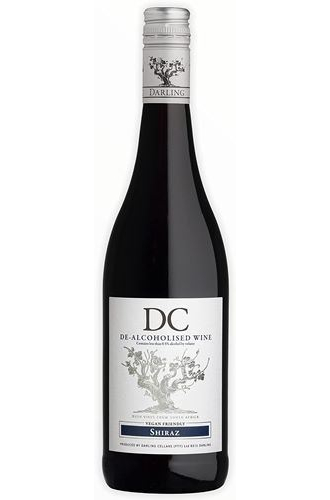
Dealcoholised Darling Cellars Shiraz
Getting the balance right in an alcohol-free red wine is no mean feat. Darling have done it with this authentic Shiraz, full of ripe red fruit and crushed black pepper flavours.